





A new model developed and implemented by the Regenstrief Institute and Indiana University Health provides chaplains with a framework to deliver better care to families and surrogate decision makers during health emergencies.
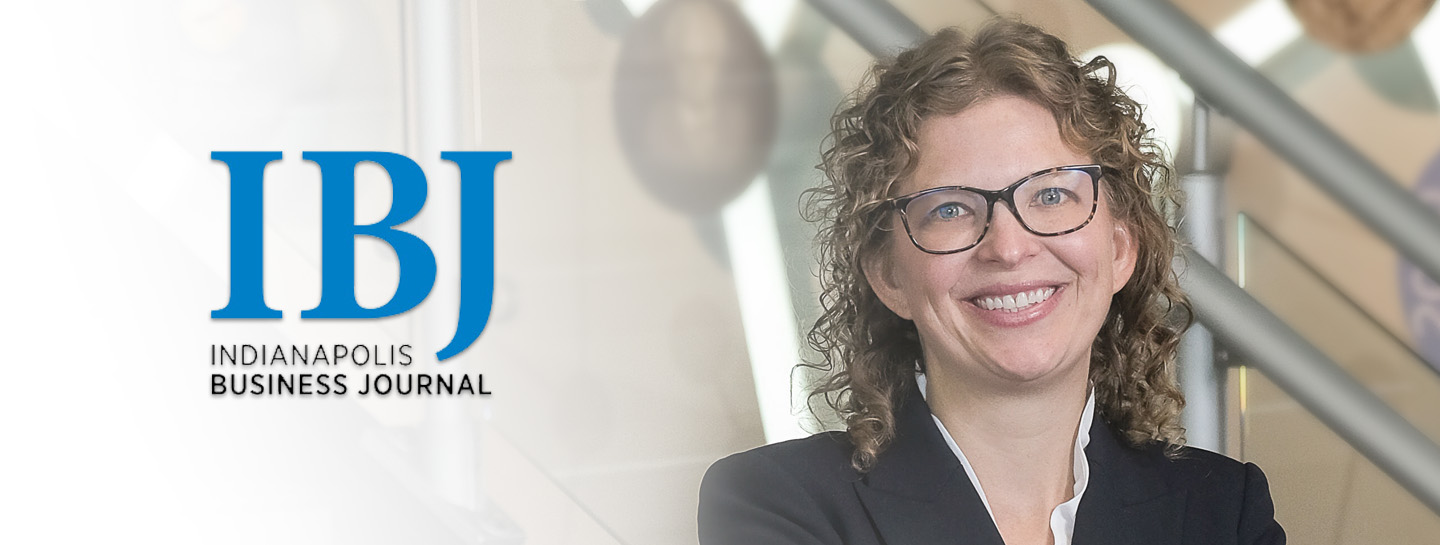
“In times of crisis, patients and their families turn to hospital chaplains to provide spiritual support,” says Alexia Torke, M.D., lead author of a study in the April issue of the Journal of Health Care Chaplaincy. “While chaplains serve a powerful role supporting the families of people in the hospital, previous research has shown that many families miss seeing a chaplain in intensive care settings because the family members have many other responsibilities such as children or jobs, or simply are not in the patient’s unit when the chaplain visits.” Dr. Torke is a Regenstrief Institute research scientist and Director of the Daniel F. Evans Center for Spiritual and Religious Values in Healthcare at Indiana University Health.
The Chaplain Family Project supported family members in the ICU when the patients were severely ill and unable to speak for themselves.
The team of chaplains, physicians and researchers developed and implemented a new model for framing chaplain visits. The Spiritual Care Assessment and Intervention (SCAI, pronounced “sky”) framework, was designed to help chaplains provide proactive, semi-structured spiritual care to meet family members’ needs while being responsive to each person’s spiritual or religious preferences.
The SCAI framework defines spirituality broadly to include concerns about meaning, purpose and relationships as well as connection to God or another higher power. It can be tailored to support patients or family whether they are religious or not.
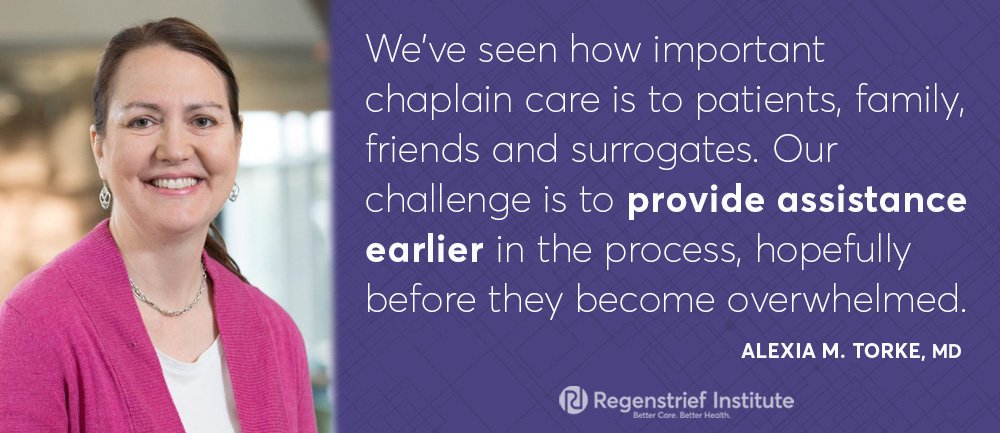
“We’ve seen how important chaplain care is to patients, family, friends and surrogates,” continued Dr. Torke. “Our challenge is to provide assistance earlier in the process, hopefully before they become overwhelmed.”
In the study, chaplains recruited 25 family members of hospitalized individuals. Each received at least one proactively scheduled visit from a participating chaplain. Visits took place either in-person or by phone, so chaplains could reach out to family surrogates wherever they were at the time. The new framework provides conversational pathways for the chaplain to explore areas where the greatest needs of the individual lies, including spiritual wellbeing and relationships with loved ones.
This novel work from Dr. Torke and her team shows promise in empowering chaplains to be even more effective in their spiritual care for families of patients in the ICU. Participating family members reported they felt emotionally and spiritually supported by the program, and overwhelmingly indicated that they would recommend similar chaplain services to other families in similar situations.
“The SCAI framework was very helpful for us as chaplains,” said Saneta Maiko, PhD, M.S., of Indiana University Health, co-author and study interventionist. “It allowed us to have deeper conversations that addressed family members’ distress much more effectively.”
Authors of “The Chaplain Family Project: Development, Feasibility and Acceptability of an Intervention to Improve Spiritual Care of Family Surrogates” in addition to Drs. Torke and Maiko, include Emily Burke, B.A. and Ann Cottingham, M.A., both of Regenstrief Institute; Beth N. Watson, MDiv, Indiana Conference of the United Methodist Church, Kianna Montz, M.A., Sarah A. Rush, B.S., Robyn Axel-Adams, MDiv, and Kathryn Kozinski, MDiv, all of Indiana University Health; James E. Slaven, M.S. of Indiana University; and Steven S. Ivy, PhD of the Association of Clinical Pastoral Educators.
The Latest